What mastery in martial arts is made of
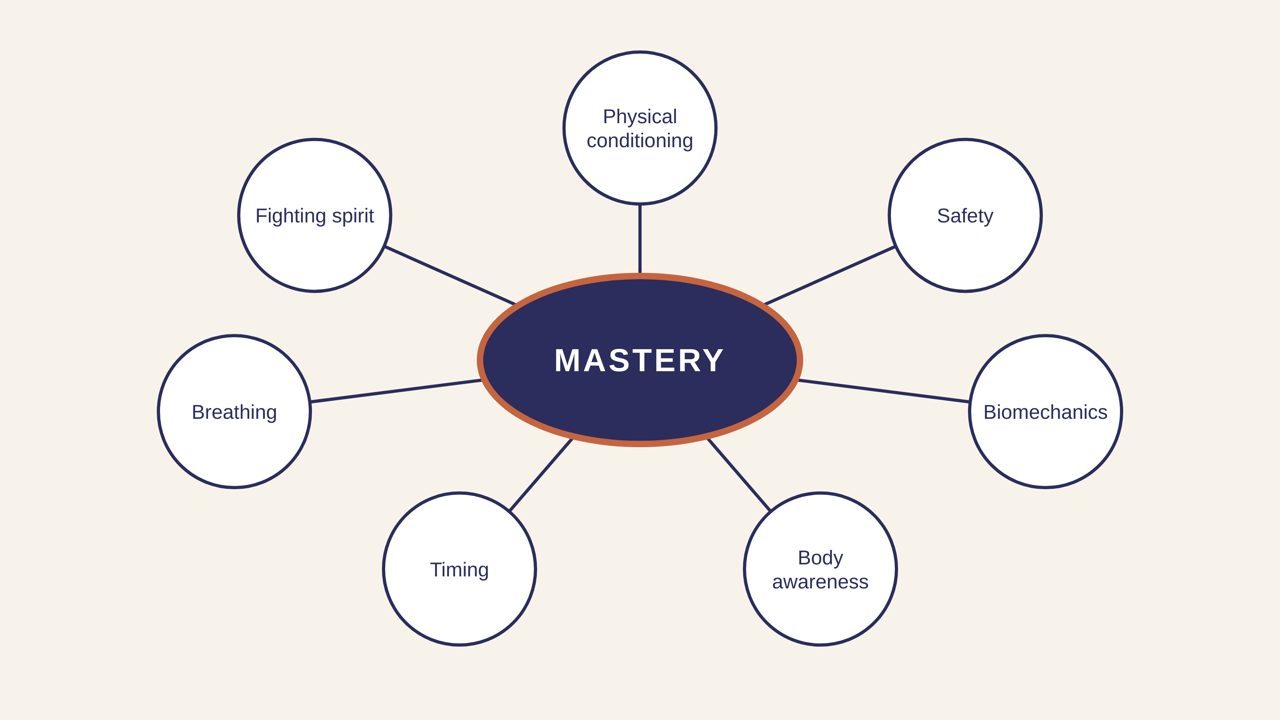
Many people who are far from any idea of using their body in a fight sooner or later come to think it would be good to learn how to fight. We are talking about those who either have no experience of ordinary fights at all, or whose experience was a bad one.
In a real combat situation the brain works quite differently from everyday life, so a person has almost no data to reflect on — what did I do wrong? All the more so if they have never been in a combat situation. Hence the first rule: martial arts cannot be learned on your own. You need a partner, and better still a group of beginners like yourself. Individual lessons with a sensei help a great deal at higher levels, but not at the start: that is how our brain is built when it learns complex body movements, and this deserves a separate conversation.
The whole body of knowledge and skill of a person walking the path of a martial art can be divided into several large parts. Only together do they make a master. Masters of combat sports and experienced instructors of special forces units may well argue with some of these points — but only with the points at the highest level, because their goals are different. Sports professionals prepare people to win in competition. Special forces fighters put attacking skills first and defence second. We are talking about ordinary people who want to learn to defend themselves properly and avoid serious consequences. A reasonable person should always try to follow the principle attributed to Sun Tzu: the best battle is the one that never happened. The goals differ, but the foundations are the same everywhere.
Health
Different schools and styles make different demands on health. The highest are in striking schools, somewhat lower in grappling ones. There are schools that present themselves more as health practices — with smooth, wide movements. In any case, if someone who wants to train has any doubts, they should ask a competent doctor and, having found out what loads are acceptable, only then choose the art and the school.
1. General physical conditioning
Many who start martial arts believe there are some "magic techniques" that will let them deal with any opponent. That is understandable: a person has watched a high-level master perform, and the techniques looked like "magic". But behind such "magic" stands serious preparation of the body; without it there will be no "magic". There is no magic pill.
The point is not that you must be physically stronger than most people, but that the vast majority of techniques cannot be learned without a prepared body. At the same time, once a technique is learned, performing it takes far less strength than learning it did.
There is a minimum worth having in order to train effectively. Otherwise the first months will go into catching up on fitness rather than learning techniques. Here is a very short list — it has three parts: strength, flexibility and endurance.
- Run 2 km at a moderate pace.
- Do at least 20 sit-ups.
- Do at least 10 push-ups.
- Do at least 5 pull-ups.
- Do at least 5 dips on parallel bars.
- Do at least 20 squats.
- Touch the floor with your fingers in a forward bend.
A completely untrained person needs about six months to reach these numbers. This is not a ticket to the dojo — most schools take you as you are, and general conditioning is part of training. It is a benchmark: until you reach it, progress will be slower.
A separate word on strength training. Working for muscle mass in the gym will not move you in the right direction and may even do harm: large muscle volume without work on mobility stiffens the body, which reduces reaction speed and range of movement. The aim is for a muscle of moderate mass to give the maximum range of movement with the required force. The same applies to ligaments and joints: they should be flexible and elastic, not rigid and locked up.
2. Safety
Another important part of learning martial arts is knowing how to fall.
At the start of training, a couple of dozen rolls at the very least should not lead to dizziness, loss of coordination or heavy fatigue. The practitioner must be able to fall without injury, get up quickly into whatever position is advantageous at that moment, and be in a state to continue the fight.
Most martial arts have many breakfalls (ukemi) — ways of falling safely — that allow you to avoid injury and withstand long training sessions. Good command of breakfalls is one of the main skills that speed up the path: it lets you and your partners practise more complex and more dangerous techniques.
3. Biomechanics
This is probably the first thing beginners get to know through their own sensations. It applies most of all to grappling arts such as judo. The idea is that parts of a partner's body can be used as levers, and by understanding what bends where and how far, you can put a partner into positions where it genuinely hurts. Joint locks, pins and knowledge of pressure points exist in practically every grappling school.
This is a necessary stage in understanding martial arts, but a short one. The practitioner quickly discovers that against a stronger partner their technique stops working.
Yes, joint pain is very intense, and most people can hardly bear it. It continues to be used in pins — but more as a threat of pain than pain itself. Of course, with such techniques one can easily break a collarbone, dislocate a shoulder or immobilise someone by acting on the Achilles tendon. But within a couple of beginner grades the practitioner gradually moves away from pure biomechanics towards working with the body as a whole — more on that below.
4. Body awareness
The next part is a little harder to grasp. It is the ability to keep the body centred — in a state of relaxed readiness, when you are not tense, yet ready for any movement. If the body is very tense, the ability to gain speed drops sharply. If it is very relaxed, the reaction to an external action drops sharply. The truth lies in the middle: you need a balance between relaxation and tension. A practitioner may search for this balance for years, and everyone's is different.
The search for and training of this state begins with stances (kamae). Stances differ between martial arts, but a stance is not merely an advantageous arrangement of the body for a fight — it is a state of readiness, and the tool by which we train being centred. This is hard to explain to beginners, but with long training comes an understanding of what it means to be centred: a state in which the body is ready to act as a unified whole, not as a set of parts on hinges.
Having understood what it means to be centred, you can move on — to moving the body as a single whole. This lets you put the whole mass of the body into a technique. For example, a punch thrown with the arm alone, by the extensor muscles, is many times weaker than a punch with the turn of the torso, hips and legs. Any boxer or karateka will tell you this — there, engaging the whole body at the moment of impact gets special attention. Engaging the whole body makes any technique effective even for people of modest strength and weight.
Mastering movement while staying centred leads to the next step: the practitioner begins to feel the centre of mass of their own body — first in stances, then in motion. In a static position this centre lies in the lower abdomen; this is what Eastern schools call the centre of ki (qi). In motion it shifts, and at some point the practitioner begins to feel that. Techniques become more effective and more economical.
With this sensation comes the sensation of the partner's centre of mass too. And then one can come to understand how to perform techniques by taking the partner off balance. This raises their effectiveness and economy even further. This is exactly what can be seen in many martial arts films: an attacker throwing a straight punch suddenly falls, with his feet ending up above his head. At a high level of training it really does look like "magic".
5. Timing
None of the above will make a practitioner a master without understanding the principle of timing. Put simply, timing is the ability to be in the right place at the right time. This principle, combined with a prepared body, is what looks like real "magic".
For example, a partner throws a straight punch. If the practitioner reacts too early, the partner, meeting resistance, may manage to abandon the attack. If the practitioner reacts too late, they will have to work against the whole mass of the partner's body, and that will be a problem. But if the action comes at the right moment, the partner can no longer abandon the attack, and the mass of his body and the energy of his movement become the practitioner's allies: the technique can be performed using the attacker's own motion.
How to train this ability is a very difficult question, and it deserves a separate conversation. With long training the skill develops, but it takes several years at the very least, and it truly works only at high levels of mastery. In the beginning it is enough to know that it exists and that the whole path leads to it.
6. Breathing
One more important skill is breathing. Correct breathing makes a technique more effective.
In its simplest form this is trained by adding a sharp exhalation with a shout to the technique — as in karate schools, where a sharp "kiai" is shouted while performing a technique. But conscious work with breathing comes at high levels, when everything else in the technique is already in place and it can be made more effective still. While the practitioner's form, centredness, sense of centre and timing are not yet in order, a shout can at best frighten the opponent. At the beginner level the effect of breathing on technique is minimal — but it is worth knowing about from the very start.
7. Fighting spirit
To close, one cannot leave out a factor such as "fighting spirit".
It is what gathers everything described above into a unity of body, mind and will. In a fight it gives the ability to be "here and now" — a state of maximum purpose. It is the key component that most often makes it possible to realise the principle "the best battle is the one that never happened": an opponent senses the fighting spirit of the other, and if that spirit is strong, in the overwhelming majority of cases he declines to attack at all.
This also includes the ability to stay calm and confident during a fight. Without it, timing cannot be used: as soon as even a drop of fear or doubt enters the mind, the surge of adrenaline breaks precision and judgement — there is a reaction, but no right action.
No less important, fighting spirit lets you "take a hit". Even if the opponent's attack succeeded, but the person attacked managed to pull himself together and continue the fight, this has a strong effect on the attacker's psyche. Inexperienced street fighters usually count on finishing everything with one punch or one move, and do not see what is happening as a fight. When that pattern breaks, the initiative easily passes to the person attacked — and that decides the outcome.
Above are the facets of martial arts that turn a student into a master. Only together do they give what we see in the performances of high-level masters.
And in training, fighting spirit shows itself simply: the practitioner keeps training even when something has not been working for a long time or there is no visible overall progress. Our brain is built so that the quality of learning grows not smoothly but in jumps. The ability to train persistently in spite of failures will certainly lead to higher levels of mastery.
And what sets aikido apart is precisely that the balance between all these facets is built from the very beginning of the student's path.
For parents
If you are reading this while choosing a club for your child — everything above applies to children too, only stretched out in time. In the first months the child will not be "fighting" but running, rolling, learning to fall and to stand in a stance — and that is right: this is exactly how safety, centredness and body awareness are laid down, without which technique will never appear. It is the opposite that should put you on guard: if in the first lessons the child is immediately taught throws and joint locks, if there is no warm-up and no breakfalls, if the coach promises quick results. A good sign is when the coach talks about discipline, patience and falling more than about moves, and when the child comes home from training tired but not beaten up. And the most important item on the list above, for a child, is the last one: fighting spirit at a young age is simply the habit of going to training even when things are not working out. A club gives this habit for life, even if the child never becomes a master.